
Bank-Side Gambling Blocks on UK Mastercards: Monzo, Starling, Barclays Compared
 Available in US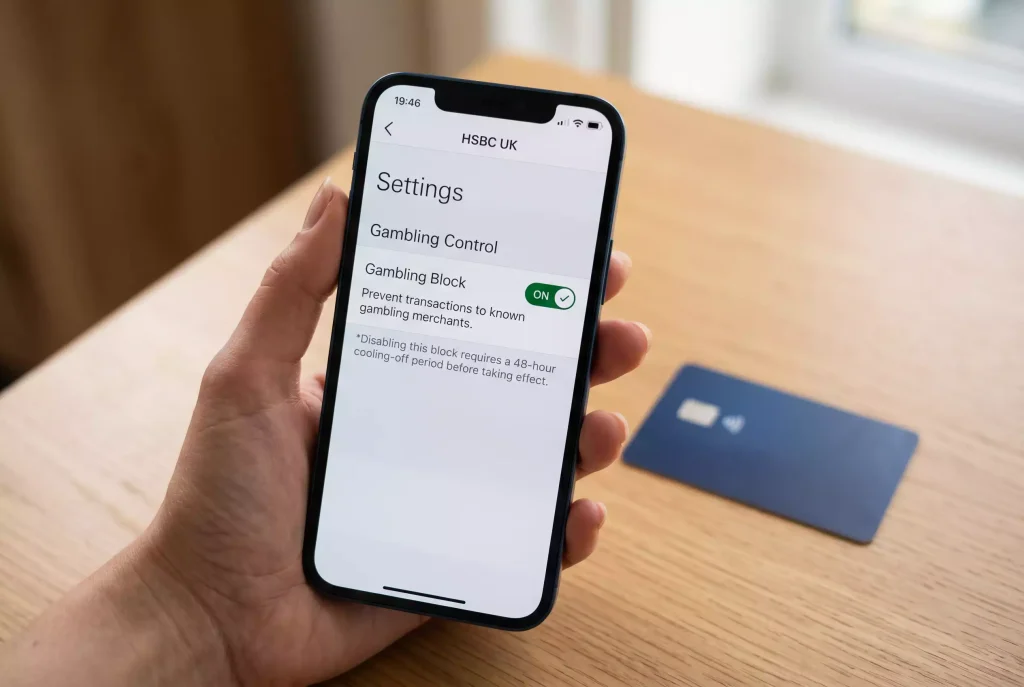
The 48-hour wait that saves more money than any budgeting app
A friend of mine — a software engineer, not a gambler but a reasonable case study — once toggled off his Monzo gambling block at 11pm on a Friday night with a firm intention to deposit £200 at a sportsbook before the Saturday fixtures. Monzo told him the block would lift in 48 hours. By Sunday morning the impulse had passed. He did not deposit, the block re-engaged automatically, and that 48-hour window is — in his telling — the single most useful piece of personal finance software he has ever used. The design insight is worth naming. A block that anyone can turn off in an instant is not really a block; a block with a cooling-off period is a genuine intervention.
UK bank-side gambling blocks on debit Mastercards have become standard across the major issuers since Monzo introduced the feature in 2018, and in 2026 the framework is broad enough to compare across banks in useful detail. This piece walks through how opt-in gambling blocks actually work at the authorisation level, the specific implementations at Monzo and Starling, how Barclays, Lloyds and Nationwide handle the same feature, what the cooling-off periods look like in practice, and how the block interacts with digital-wallet deposits and travel holds.
How an opt-in gambling block actually works
The mechanism sits entirely at the issuer’s authorisation engine. When a customer toggles the gambling block on in the banking app, a flag is set against the account that instructs the engine to decline any transaction flagged with a gambling Merchant Category Code. The relevant codes are MCC 7995, which Mastercard uses broadly for gambling and betting transactions, and MCC 7801, which is specifically used for US regulated internet gambling.
The check fires in real time. A Mastercard authorisation message arrives at the issuer carrying the MCC; the engine reads the MCC; if the account has the gambling block active, the transaction is declined with a specific response code. The decline happens in milliseconds, and the operator’s cashier receives a standard “do not honour” message without any indication that the decline was caused by a gambling block rather than insufficient funds or any other reason.
This MCC-based approach is why the block works at both licensed and offshore operators. The MCC is attached by the acquirer when the transaction is created, and it travels with the transaction regardless of where the operator is based. A UK debit Mastercard with an active gambling block will decline deposits at UKGC-licensed operators, US-licensed operators, and offshore books alike, because the block fires on the category code rather than the operator’s identity.
The block does not affect non-gambling merchants. A cardholder with an active gambling block can still pay for restaurant meals, retail shopping, and any other normal purchase; only transactions coded at gambling MCCs are declined. The narrow targeting is what makes the feature easy to live with — you toggle it on and forget about it, and only the specific category you wanted to block is affected.
Monzo’s gambling block
Monzo introduced the first mainstream bank-side gambling block in the UK in 2018, and its implementation has become the de-facto template other banks copied. The feature sits in the banking app under categorical controls and can be toggled on with a tap. Toggling it off requires a confirmation and initiates a 48-hour cooling-off period before gambling transactions are allowed through.
The 48-hour design was not arbitrary. It was chosen to be long enough to survive a single emotional episode — the Friday night after a bad week, the aftermath of a specific triggering event — but short enough that a considered decision by a non-problem user to place an occasional bet was not unreasonably delayed. The design has been copied precisely because the evidence that 48 hours is the right number was built into the original rollout.
Monzo’s implementation is MCC-based in the standard way, so it fires on both MCC 7995 and MCC 7801. The bank has also historically extended the block to some adjacent merchant categories — certain lottery products, some prediction-market operators — though the exact scope varies over time as the bank updates its MCC mappings.
One practical detail: the block treats digital-wallet deposits (Apple Pay, Google Pay with a Monzo Mastercard) the same as direct card deposits. The MCC is attached by the acquirer and travels with the transaction regardless of whether the card number was entered directly or tokenised through a wallet.
Starling’s gambling block
Starling introduced a comparable gambling block shortly after Monzo, with a similar philosophy and a similar implementation. The toggle sits in the banking app, fires on gambling MCCs, and applies a 48-hour cooling-off period before a turned-off block can be bypassed.
The differences with Monzo are subtle but real. Starling’s block has historically been slightly more aggressive in its MCC coverage, including some categories that Monzo’s block does not. Customers who have used both have sometimes reported declines at merchants they did not expect to be captured — spread-betting platforms, for example, or some skill-games products that sit at the edge of the gambling definition.
Starling’s cooling-off confirmation flow is marginally stricter. The bank requires explicit acknowledgement that the customer understands gambling can be harmful before allowing the toggle to be turned off, and the 48-hour window is presented prominently rather than buried in small print. This is a design choice that prioritises friction at the moment of toggling.
For a customer choosing between a Monzo and a Starling block, the functional difference is small enough that most people choose based on which bank they already use for their primary account. Both blocks catch the vast majority of gambling-coded transactions, both apply the cooling-off, and both have been stable features for years.
Barclays, Lloyds and Nationwide
The traditional UK high-street banks came to the gambling block feature later than the challenger banks but have now implemented it across their major debit Mastercard portfolios. The specifics vary.
Barclays introduced its gambling block in 2018–2019 and has refined it several times since. The toggle sits in the mobile banking app under “Turn Off Transactions”. The cooling-off period is 72 hours — longer than the challenger banks’ 48 — reflecting Barclays’ framing of the tool as a substantive self-protection measure rather than a convenience toggle.
Lloyds Banking Group — covering Lloyds, Halifax and Bank of Scotland — offers a similar feature with a 48-hour cooling-off. The implementation is comparable to Monzo’s and Starling’s in coverage, firing on standard gambling MCCs across all debit Mastercard products within the group.
Nationwide’s gambling block sits inside its Internet Banking and mobile app. The cooling-off is also 48 hours. Nationwide has been explicit that the block covers all gambling-coded transactions without carve-outs, and the feature is actively promoted as part of the building society’s responsible-banking positioning.
Across these three high-street providers the common design emerges clearly: opt-in rather than opt-out, MCC-based rather than merchant-based, cooling-off rather than instant-unlock. The 48-to-72-hour range is consistent, and the coverage of all gambling MCCs without material carve-outs is universal. The differences are at the margins — a specific MCC here, a confirmation-flow choice there.
Cooling-off design and why it matters
The cooling-off period is the feature that separates a genuine harm-reduction tool from a branded toggle. Every major UK implementation builds in a mandatory delay between the decision to turn the block off and the moment gambling transactions can succeed again, and the design choice is supported by what evidence from adjacent responsible-gambling frameworks shows about interruption timing.
The 48-hour number is the most common and has become the default. It survives a Friday night without being so long that an occasional bettor finds it intolerable. A 72-hour period, as Barclays uses, takes the principle further — it survives an entire weekend — and the slight additional friction is intentional. Less than 48 hours has historically proven too short: the impulse that drove the toggle-off is often still present a day later and the block’s purpose is defeated.
The cooling-off also interacts with the interaction between issuer-side policies and MCC-based decline patterns. Card-issuing policy on MCCs is what sits behind the broader iGaming decline-rate landscape that runs at 30 to 40 percent against 5 to 10 percent in ordinary e-commerce, and opt-in gambling blocks are one mechanism inside that landscape. A closer look at the downstream cost side of gambling spending on a credit product — a related but distinct issue from debit-side blocks — sits in this analysis of how cash-advance fees on Mastercard gambling deposits actually land.
Worth noting what the cooling-off does not do. It does not provide full self-exclusion of the kind GamStop delivers; it is a user-controlled tool that the user retains full power to reverse, after a delay. It does not affect transactions at the operator level — the cashier never sees the block, only the authorisation engine does. And it does not persist across card replacements — if the underlying debit account gets a new card, the toggle setting persists, but some edge cases with new product lines require re-toggling.
The wider context is set out in our Mastercard betting breakdown.
The operator-side register is GamStop.
