
Cash-Advance Fees on Mastercard Gambling Deposits: How the Charge Really Lands
 Available in US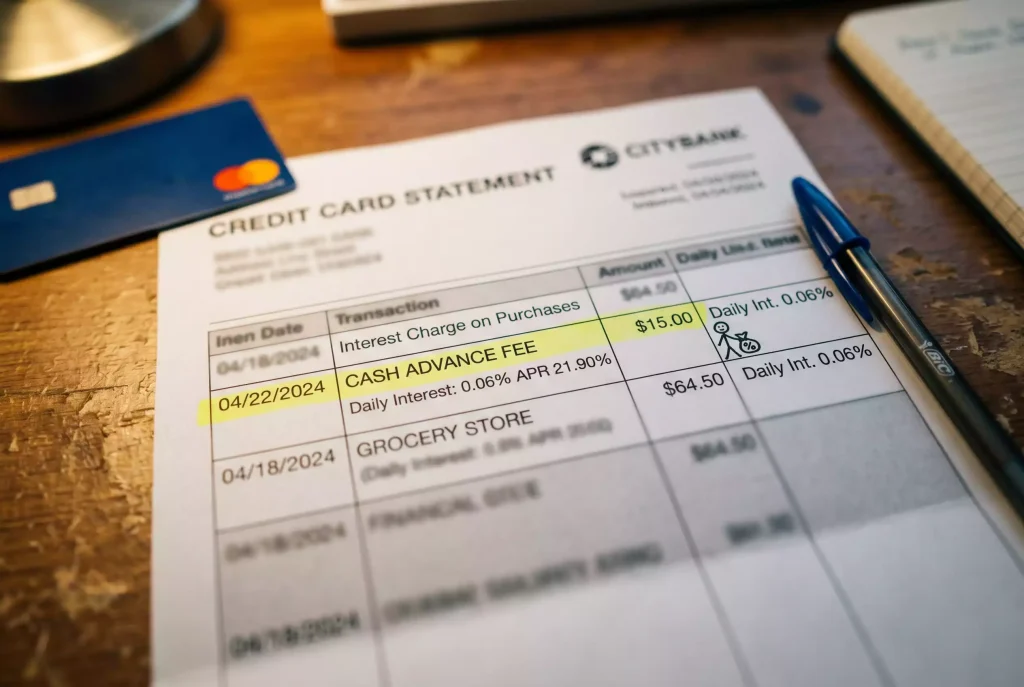
The $5 fee that quietly cost $47
A reader sent me a statement screenshot last summer with a question that turned out to be a useful case study in how cash-advance charges actually accumulate. He had deposited $200 at a regulated sportsbook with a credit Mastercard. His statement showed a $5 cash-advance fee, which he noticed immediately and shrugged off. What he had not noticed was the 25.99 percent APR flag on the cash-advance line and the absence of the normal grace period. Six weeks later, when he paid off the statement in full, he had also paid $42 in accrued interest on that single $200 deposit because cash-advance interest starts the moment the transaction posts and does not pause for the billing cycle. Total cost of a $200 deposit: $47 in fees and interest, against the $5 flat fee he thought he was paying.
Cash-advance treatment of gambling deposits is one of the most consistently misunderstood parts of credit-card economics in the betting market. The fee is not the whole story; the APR and the grace-period absence are. In the US, 24 percent of sports bettors have used a credit-card cash advance to fund bets, 16 percent have used a personal loan, and 12 percent have used a payday loan — data that describes a pattern of credit-funded gambling that runs into exactly the fee structure this article explains. This piece walks through what a cash advance technically is, why some sportsbook deposits get coded as cash advances, the typical APR and fee combination, which issuers code gambling that way, and how to spot it on your statement.
What a cash advance actually means on a credit card
A cash advance is a specific type of credit-card transaction that moves immediately-available cash or cash-equivalent value to the cardholder. The canonical cash advance is withdrawing cash from an ATM with a credit card. The cash-advance category also covers a handful of transaction types the network classifies as cash-equivalent: wire transfers, money orders, certain prepaid-card loads, and — critically for this article — most gambling-related transactions.
The cash-advance classification carries three consequences that together make it a significantly more expensive transaction than a normal purchase. First, a flat fee typically applies per transaction — usually 3 to 5 percent of the amount with a minimum of $10. Second, the APR is typically higher than the purchase APR, often by 5 to 10 percentage points, and on some cards materially higher. Third — the hidden one — the transaction does not enjoy the grace period that applies to purchases. Interest accrues from the transaction date, daily, at the cash-advance APR, until the balance is paid in full.
The third point is what catches people. A $200 cash advance with a 5 percent fee and 26 percent APR, held for 45 days before full payment, costs around $16 in interest on top of the $10 flat fee — $26 total, or 13 percent of the transaction value. The same $200 made as a regular purchase and paid off at the end of the billing cycle would cost $0. The effective cost of a cash-advance-coded transaction is radically higher than the fee alone suggests.
For a bettor depositing multiple times over a month, the effect compounds. A dozen $200 deposits coded as cash advances generate a running interest charge that continues accruing on the unpaid portion from the moment each transaction posts. The monthly statement balance grows at a pace that surprises cardholders who have previously only paid off purchase balances.
How a sportsbook deposit becomes a cash advance
The classification is decided by the network and the issuer based on the Merchant Category Code attached by the acquirer. MCC 7995 — Gambling Transactions — is treated by most credit-card issuers as a cash-advance-category MCC. Some issuers also treat MCC 7801, the US-regulated internet gambling code introduced more recently, as a cash-advance MCC; others treat it as a standard purchase MCC.
Here is why the split matters. The older MCC 7995 has been classified as cash-equivalent for decades, reflecting the historical treatment of casino chip purchases and similar transactions. When US regulated online sports betting began to scale in the 2018–2022 period, Mastercard introduced MCC 7801 partly to give issuers a cleaner way to distinguish regulated domestic operators from the legacy gambling pool. Some issuers took the opportunity to treat MCC 7801 as a normal purchase; others kept the cash-advance treatment consistent across both MCCs.
The result is that a deposit at the same US-regulated sportsbook on two different credit Mastercards from two different issuers can have radically different cost profiles. One might post as a regular purchase with no flat fee and the standard purchase APR; the other might post as a cash advance with a 5 percent fee and a 26 percent APR. The bettor has no reliable way to predict which treatment applies without asking the issuer or testing the first deposit and reading the statement.
The cashier at the sportsbook does not and cannot tell you how your issuer will code the transaction. The operator is responsible for the MCC; the issuer decides what to do with it. Some issuers publish their gambling-MCC policy clearly in their card agreements; many bury it in fine print; a few leave it to customer service to answer case-by-case.
Typical APR and fee combinations in 2026
The range on cash-advance fees and APRs has been stable for several years, even as the underlying gambling economics have shifted. The combinations I see consistently are within predictable bands.
Flat fees run from 3 percent to 5 percent of the transaction, with a floor of $10 on most cards. A $50 deposit triggers the floor and costs $10 in fees — a 20 percent effective fee on that single transaction, which is why small frequent deposits on a cash-advance-coded card are disproportionately expensive. A $500 deposit at 5 percent costs $25 and hits above the floor, giving a flat effective rate.
APRs on cash advances run from roughly 22 percent to 30 percent, with the median sitting around 25 to 27 percent. Compare this to purchase APRs on the same cards, which typically sit 3 to 8 points lower. The cash-advance APR is always higher than the purchase APR, never lower, and the gap is meaningful.
The true total cost depends on how quickly the balance is paid. A bettor who pays the statement in full on the due date pays the flat fee plus about 30 days of interest. A bettor who carries the balance for 60 days or 90 days pays proportionally more. This is where the US research on sports bettor finances becomes relevant. 52 percent of American sports bettors carry a credit-card balance from month to month, and 30 percent of them attribute at least some of their debt to gambling — numbers that describe exactly the pattern where cash-advance treatment becomes financially material. A single deposit coded as a cash advance on a balance carried across multiple months can compound into a meaningful share of the original stake.
A practical calculation for bettors who want to understand the real cost: take the flat fee, add 2 percent per month for as long as the balance is carried, and treat that as the effective transaction cost. A $200 deposit at 5 percent fee carried for three months costs $10 plus roughly $10 in interest — $20 total, or 10 percent of the stake. That is the real cost of the deposit before any bet is placed.
Which issuers code gambling as cash advance
I cannot publish a comprehensive bank-by-bank list because the policies change and the language in card agreements is often ambiguous. I can describe the pattern I observe across reader reports and my own testing in 2026.
Most US credit-card issuers code MCC 7995 transactions as cash advances by default. This is the safer and more conservative position for the issuer because it mirrors the network’s historical classification. The set of issuers that treat MCC 7995 as a normal purchase is small and shrinking.
The US-regulated MCC 7801 picture is more mixed. Some issuers have updated their systems to treat MCC 7801 as a normal purchase, reasoning that regulated domestic gambling at licensed operators carries a risk profile comparable to ordinary e-commerce. Other issuers treat MCC 7801 as a cash advance consistent with their broader gambling policy. The split is roughly even across the major US issuers at the end of 2025, with no clear trend toward either outcome.
Outside the US the picture is simpler because most markets either ban credit-card gambling outright (UK, Australia) or have issuer policies that heavily restrict it. The cash-advance coding question matters mainly where credit-card gambling is actively legal and common — which is a smaller set of markets than it was five years ago. For anyone wanting to understand the fees that the operator and network charge behind the scenes — separate from the issuer’s cash-advance treatment — this breakdown of how Mastercard interchange on gambling merchants works and who actually pays provides the other half of the picture.
How to detect cash-advance treatment on your statement
The statement is the source of truth, and knowing how to read it matters. A cash-advance-coded transaction appears on the statement with specific features that distinguish it from a purchase.
The first signal is the presence of a separate cash-advance fee line. A $200 transaction with a $10 fee appearing as a separate entry is unambiguous evidence of cash-advance treatment. Some issuers label the fee explicitly (“Cash Advance Fee”), others use more neutral language (“Transaction Fee”) — either way, a fee line near a gambling transaction is a red flag.
The second signal is the APR breakdown at the end of the statement. Most credit-card statements include a section summarising the purchase APR, the cash-advance APR, and the balance subject to each. If the cash-advance balance section shows a non-zero amount following a gambling deposit, the deposit was coded as a cash advance.
The third signal, subtler, is the absence of the grace-period indicator on the transaction line. Purchase transactions are covered by the grace period if the balance is paid in full each month; cash advances are not. Some issuers mark this distinction explicitly on the statement; others leave it to the cardholder to deduce from context.
If any of these signals is present on a deposit, the transaction was coded as a cash advance. The remedy is to pay the balance immediately — every day of delay costs additional daily-accruing interest — and to switch the funding method for future deposits.
The wider context is set out in our Mastercard betting breakdown.
Every other charge line is listed in Mastercard fees on deposits.
