
Mastercard Withdrawal Timing at Sportsbooks: From Request to Cleared Funds
 Available in US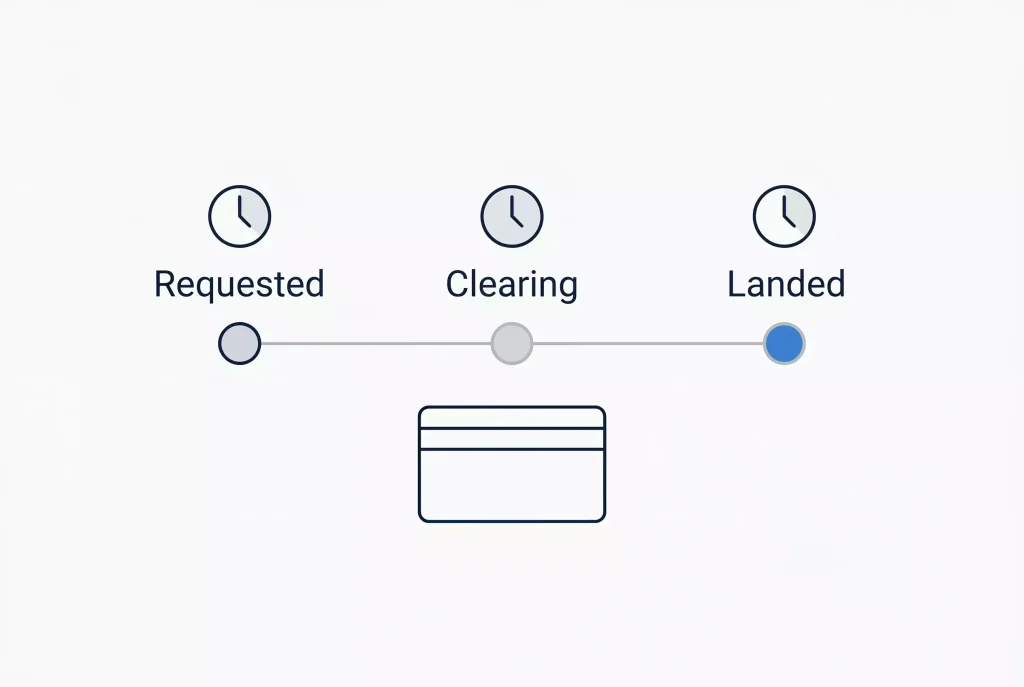
Why the same $400 clears for one player in minutes and another in three days
A reader sent me two screenshots last spring. Same sportsbook, same amount, same debit Mastercard type. Her $400 withdrawal cleared to her available balance in 14 minutes. Her husband’s $400 withdrawal, requested 11 minutes later on his own identical card at the same operator, sat in “pending” for 46 hours. No error message, no communication, no obvious reason. The couple’s conclusion — that the sportsbook was throttling them deliberately — was wrong, but understandable. The real explanation lives in how a Mastercard payout actually moves through three distinct stages, and why each stage can stall on factors the player never sees.
Most sportsbook timing guides collapse the process into a single number: “withdrawals take 1 to 3 days”. That number is a fiction. A payout goes through a pending-review stage at the operator, a clearing stage at the network, and a landing stage at the issuer — each with its own timing characteristics and its own failure modes. Understanding the three stages is the difference between panicking at hour 12 and patiently waiting at hour 12 because you know exactly where the money is.
The three stages of a Mastercard sportsbook withdrawal
Stage one is pending review at the operator. From the moment you click “withdraw” until the moment the operator fires the outbound payment message, the transaction sits inside the operator’s systems. This stage includes the automatic fraud and AML scoring, any required manual review, and the generation of the outbound instruction. Typical duration for a verified account on a well-run operator is 30 seconds to 10 minutes. For a new account, a large payout, or an account with a recent risk flag, it can extend to 24 to 72 hours.
Stage two is clearing to the card. Once the operator fires the Original Credit Transaction message, the payment moves through the acquirer, across the Mastercard network, and into the issuer’s acceptance queue. If the operator is using Mastercard Send or an equivalent push-to-card rail, this stage takes seconds to a few minutes. If the operator is using a legacy settlement rail — batched ACH to the acquirer, then acquirer push to issuer — this stage takes one to three business days.
Stage three is the issuer posting the credit to the cardholder’s available balance. Most issuers post incoming OCTs in near real time, so this stage is usually negligible. A minority of issuers — some smaller banks, some credit unions, some foreign issuers — queue the posting and release it in batches, adding minutes to hours.
The timing you see as a player is the sum of the three stages. A fast sportsbook is not just one that fires quickly; it is one that fires quickly to an eligible card at a responsive issuer. A slow payout is not necessarily a slow operator; it can be a fast operator firing to an issuer that only posts OCTs every four hours.
Pending review — where the real timing is decided
Stage one is where most of the variance in sportsbook payout timing actually lives, and it is the stage operators are least transparent about. The review is a stack of automated scoring rules followed by optional human review, and every rule in the stack can extend the timing.
Account takeover detection is the biggest automated trigger. With fraud rates in the gambling industry having risen from 4.2 percent in 2022 to 7.6 percent in 2023 — an 80 percent jump — operators have tightened their account takeover rules significantly. A withdrawal requested from a new device, a new IP range, or a geolocation that does not match the player’s usual pattern gets routed to review automatically. The review clears as soon as the player completes a verification challenge, usually an email or SMS confirmation, but a challenge sitting unanswered in an inbox for six hours extends the payout by six hours.
Amount-relative-to-history is the second automated trigger. A payout larger than the player’s 90-day moving average hits a review queue. The review confirms the account’s source-of-funds documentation is current and the player’s betting pattern is consistent; it rarely produces a rejection, but it adds human-review time measured in hours.
AML threshold crossings are the third. Cumulative deposits or withdrawals crossing a regulated threshold — typically $2,000 or $10,000 depending on the jurisdiction — trigger enhanced due diligence. On accounts that have already cleared EDD this is a fast confirmation. On accounts that have not, it is a documentation request that can stall the payout for days.
The quiet part: human review happens in business hours. An automated flag raised at 11pm on a Friday night waits in a queue until Monday morning. An operator that advertises 24/7 support is not necessarily staffing its payment-risk team 24/7.
Clearing to the card — network timing in practice
Once the operator fires the payment message, the clearing time depends almost entirely on which rail the operator has integrated. The modern rail is Mastercard Send, and the Decision Intelligence Pro layer Mastercard added to its network in 2024 now detects compromised cards at roughly twice the previous speed — which has quietly reduced the rejection rate on clean OCTs and sped up the overall corridor.
A Send OCT clears from operator acquirer to issuer in seconds. The network authorisation is synchronous, the issuer either accepts or rejects the push immediately, and a successful accept triggers the balance update. Most of the perceived delay on a Send payout comes from the pending-review stage, not the clearing stage.
A legacy settlement payout clears on the acquirer’s batch schedule. The operator generates a batch file typically at the end of each business day, the acquirer processes the batch overnight, and the funds post to the cardholder’s account on the next business day in most cases and two business days in some. Weekend requests wait for Monday’s batch. This is the “1 to 3 business days” timeframe most operators still quote even when they have integrated Send for some cards, because the fallback for non-eligible cards is still the batch route.
The rail in play for your specific withdrawal is not always obvious. The clearest signal is the cashier’s estimated timing: sub-hour estimates mean Send; multi-day estimates mean batch. If the sportsbook gives you both options on the same card, the Send path is usually a button labelled “instant” or “fast”, and it sometimes comes with a small fee the operator passes through from the network. A full explanation of the mechanics of the instant rail itself — what OCT messages are, how eligibility works, and why debit dominates — sits in this write-up of how Mastercard Send and push-to-card payouts work.
Why your balance shows different timing than your bank app
A subtle source of confusion is the gap between what the sportsbook shows and what your banking app shows. The operator marks a payout “sent” the moment it fires the OCT. Your banking app marks the credit “posted” the moment the issuer processes it. Between those two timestamps there is a window — usually seconds, sometimes hours — where the sportsbook says “withdrawal complete” and your bank app says “no recent activity”.
This is normal. It does not mean the payout has failed. A phone call to the bank at this stage almost always produces the same answer: “we can see a pending credit, it will post shortly”. If the window extends past 24 hours for an eligible card, then something has gone wrong, and the resolution path is the operator’s support channel first, not the bank.
There is also a difference between available balance and posted balance. Most issuers add an OCT credit to the available balance immediately — you can spend it — but formally post the credit on the next business day. If you are looking at your statement for the credit it may not appear for a day or two even though the money has been spendable since the moment it arrived.
Disputed withdrawals and recovery paths
Sometimes a withdrawal fires from the operator, the money leaves the operator’s account, and it never lands on the card. This is the worst failure mode because the player has no balance to point to on either end. The cause is almost always a rejected OCT at the issuer side — typically because the card has changed status between when the operator cached its eligibility and when the OCT fired.
Recovery starts with the operator. The outbound payment message has a network confirmation ID, and the operator’s support team can pull that ID and check the network’s response. If the OCT was rejected, the network returned the funds to the operator and the balance should have been restored to the account. If the balance was not restored, the operator has to reconcile manually — a process that takes 3 to 10 business days in most cases.
If the OCT was accepted by the network but the issuer did not post it, the escalation path is the issuer. The operator can produce a “proof of payment” packet with the network confirmation, and the issuer can trace where the credit was queued or misrouted. This resolution is slower — 5 to 15 business days is typical — and it usually requires the cardholder to initiate the trace at their bank.
The lesson from handling a dozen of these cases: document the timestamp and any confirmation ID the moment the sportsbook tells you the withdrawal is complete. Screenshots of the cashier screen, the email confirmation, and the balance dropping on your account are the evidence that accelerates a trace by days if the money ever goes missing.
The wider context is set out in our Mastercard betting breakdown.
The rail that moves the money is Mastercard Send.
