
1-800-GAMBLER and Your Mastercard: What Happens When You Call the Helpline
 Available in US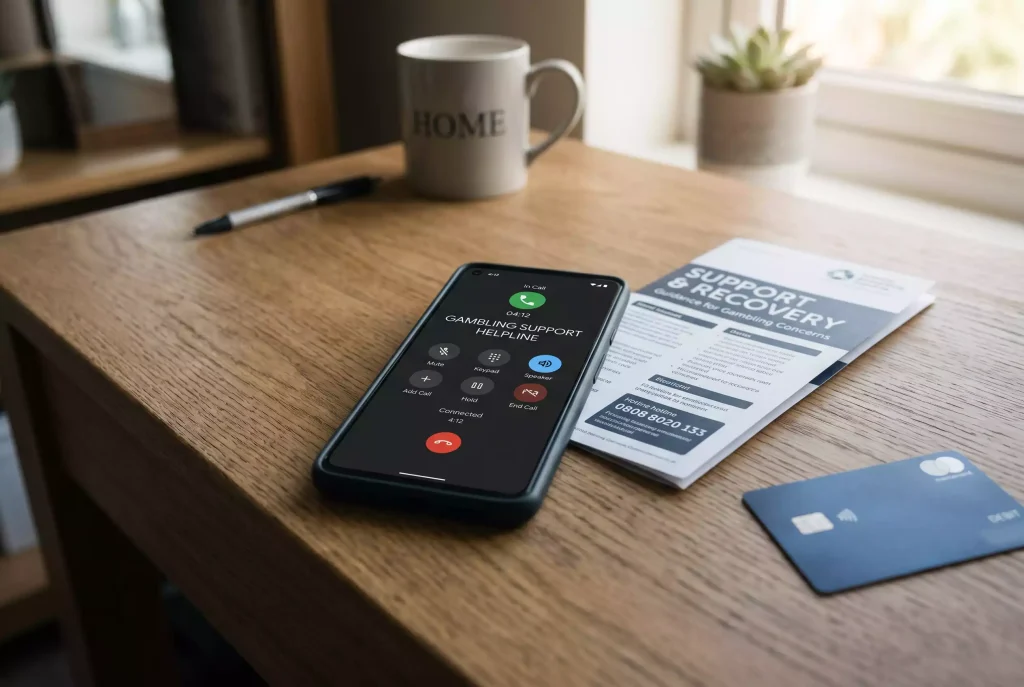
The call that saved a friend’s cashflow
A close friend — not a reader, just someone I have known for fifteen years — called the National Council on Problem Gambling helpline in the middle of a bad autumn in 2023. He had been wondering for weeks whether his sports-betting had crossed into something more than recreation, and the thing that pushed him to dial was a $4,200 credit-card statement with a pattern of deposits that felt compulsive rather than planned. He expected the call to be awkward, possibly preachy, and he was nearly right about the awkwardness — calling a helpline is not easy regardless of how well the other end is trained. He was wrong about the preaching. The conversation was practical, non-judgemental, and surprisingly focused on cashflow rather than on any diagnostic label.
The NCPG helpline handles a volume of calls that suggests many people are in the same position he was. Around 2 million Americans meet the criteria for severe gambling disorder, with another 4 to 6 million meeting criteria for milder forms — a population for whom the helpline is one of the most accessible entry points into support. For a sports bettor whose gambling has started to sit awkwardly with their finances, calling is a low-commitment first step. This piece walks through what happens on that call, whether they will ask about your Mastercard use, what they can and cannot do about the card itself, how confidentiality works with your bank, and what the practical next steps look like after the call ends.
How the helpline actually works
1-800-GAMBLER is a confidential, free helpline operated by the National Council on Problem Gambling and its affiliated state-level providers. Calls are answered by trained specialists with specific gambling-disorder expertise, not generalist operators. The service is available 24 hours a day, 7 days a week, and calls are routed to a local or regional provider where possible.
The conversation follows a standard structure but is not scripted. The specialist typically starts by asking open-ended questions about what prompted the call, what patterns the caller has noticed, and what the caller is hoping the call might lead to. There is no diagnostic questionnaire, no pressure to commit to anything, and no referral unless the caller asks for one.
The practical output of a typical first call is information — a list of local counsellors, peer support meetings, treatment programmes in the caller’s area, and resources for family members if the caller raised them. Some calls end with the specialist offering a follow-up contact; others end with the caller taking the information and deciding what to do with it later. Callers are not tracked, enrolled, or pressured.
What the helpline does not do is as important as what it does. It does not provide clinical diagnoses over the phone. It does not file reports to the caller’s employer, bank, or family. It does not add the caller to any list that affects their gambling, credit, or other accounts. The confidentiality is not marketing — it is the operational design of the service.
Will they ask about card use?
The specialist will probably ask about how gambling is being paid for, because it is one of the most useful signals about the pattern of behaviour. The question is practical, not accusatory. Funding source is diagnostic in a way that bet size or time-on-site is not.
The US sports-betting debt research that has come out in recent years supports why this matters. 24 percent of American sports bettors have used a credit-card cash advance for wagers, and the share of bettors attributing debt specifically to gambling sits at 30 percent — patterns that would be invisible without the funding-source data. For an individual caller, describing how deposits are funded gives the specialist context that shapes the rest of the conversation.
The question will typically be phrased in a practical way. “How do you fund your deposits?” or “What happens when you run out of money for a given session?” The answers are informative regardless of what they are. A caller who says “I only deposit from my current account and stop when it is empty” is in a different situation from one who says “I use a credit card and sometimes take a cash advance when the statement is due”. Neither answer triggers judgement; both shape the guidance that follows.
Disclosure about specific card numbers, account details, or amounts is not required. Specialists do not ask for personally identifiable information, and callers can share as much or as little as feels comfortable. The conversation functions even at a high level of abstraction — “sometimes I spend more than I planned to” — though specifics help the specialist calibrate recommendations.
What the helpline can actually do about your card
Let me manage expectations here. The helpline cannot directly intervene with your Mastercard. It cannot block transactions, place a freeze, contact your issuer on your behalf, or instruct any network-level restriction. Its tools are informational and referential, not operational.
What the helpline can do is point you toward tools that do work at the card level. Every major UK bank offers an opt-in gambling block on debit Mastercards; US issuers are beginning to offer similar features; Australian issuers have been aligning with the post-ban environment. The helpline specialist can walk through which blocks exist on your specific bank’s cards, how to enable them, and how the cooling-off period works if you later want to toggle the block off.
They can also help you find self-exclusion frameworks that fire at the operator level. In the US, state-specific self-exclusion registers and the emerging federal-level tools are available. In the UK, GamStop covers all UKGC licensees. In Australia, BetStop handles the equivalent role. The helpline knows which tools apply in the caller’s jurisdiction and can guide the enrolment process.
For callers who want something more immediate, the helpline can help compose a script for a conversation with their bank’s customer service. A request to add a note about gambling spending to an account, or to downgrade a credit card to a product without a cash-advance provision, is sometimes easier with a prepared script. The specialist has handled hundreds of these conversations and can offer useful language.
Finally, the helpline can help arrange referrals to debt counsellors who specialise in gambling-related debt. As the NCPG’s leadership has framed it, nationwide efforts in responsible gambling and public awareness are making a positive impact, but the work is far from over — and individual-level connections to treatment and financial support are what translate public-health framing into personal outcomes.
Confidentiality and the bank question
The most persistent caller worry is that calling a helpline might somehow be recorded against their credit file or reported to their bank. This worry is understandable and, on the specifics of the NCPG helpline, largely unfounded.
The helpline does not communicate with banks, credit bureaus, employers, or any external agency. Call records are kept internally for quality purposes and are not shared. The caller’s name and number are not required to use the service, and calls from blocked numbers or private lines are accepted.
The bank-side question is different. If a caller chooses to act on helpline guidance by calling their issuer — to ask about a gambling block, to freeze a card, to request a product change — that conversation is with the bank and follows the bank’s standard confidentiality rules. The bank is not told that the call originated from a helpline referral; the customer is simply asking for a service the bank offers.
Some callers worry that a gambling-related conversation with the bank might surface on credit reports or insurance applications. For the specific kinds of actions the helpline typically recommends — opt-in gambling blocks, card product changes, note-adding to an account — the answer is no. These are internal bank operations that do not report to external agencies. A formal account closure initiated by the bank (rather than the customer) might appear on credit reports, but that is a different scenario from customer-initiated protections.
The stronger confidentiality principle is practical rather than formal. Calling a helpline is not visible to anyone who is not looking for the call record, and nothing about the call creates a trail in ordinary financial life. For a caller worried about stigma or visibility, the helpline is genuinely private.
Practical next steps after the call
Most callers end the conversation with a small set of concrete things to do. The steps are usually a mix of bank-side actions, digital tools, and longer-term support options.
Enable whatever bank-side gambling block exists on your debit Mastercard. This is often the fastest-acting intervention — toggling the block in the banking app takes a minute and reduces opportunity for impulsive gambling spend immediately. The cooling-off period on toggling off adds substantial protection even when the block is later reversed. Detailed information about the specific blocks available at major UK banks sits in this breakdown of opt-in Mastercard gambling blocks at Monzo, Starling, Barclays and beyond.
Consider registering with the appropriate national self-exclusion service. BetStop for Australia, GamStop for the UK, state-specific services in the US. These are binding registrations that cannot be easily reversed within their periods — which is the point. They operate at the operator level and complement the bank-side block at the card level.
If credit-card debt has accumulated, make a direct plan to pay it down, starting with any cash-advance balances where interest accrues daily. The NCPG specialist may have referred you to a gambling-specific debt counsellor; taking that referral within a few days of the call maintains momentum. Debt counselling is slower to act than a bank-side block but addresses the accumulated financial stress that continuing gambling is unlikely to resolve.
Think about whether peer support — meetings with others in similar situations — might help. Gamblers Anonymous and parallel organisations are free, non-commercial, and widely available. The meetings are not a substitute for clinical treatment when warranted but can be a substantial support for many.
The final step is low-commitment but useful: save the helpline number somewhere accessible. A second call, weeks or months later, is often more productive than the first because the caller has already broken the initial barrier. Many people who eventually found sustained support did so through two or three calls rather than one.
The wider context is set out in our Mastercard betting breakdown.
The state registers are compared in self-exclusion in NY, NJ and PA.
