
Mastercard at Super Bowl Weekend: Deposit Surges, Declines and Payout Lag
 Available in US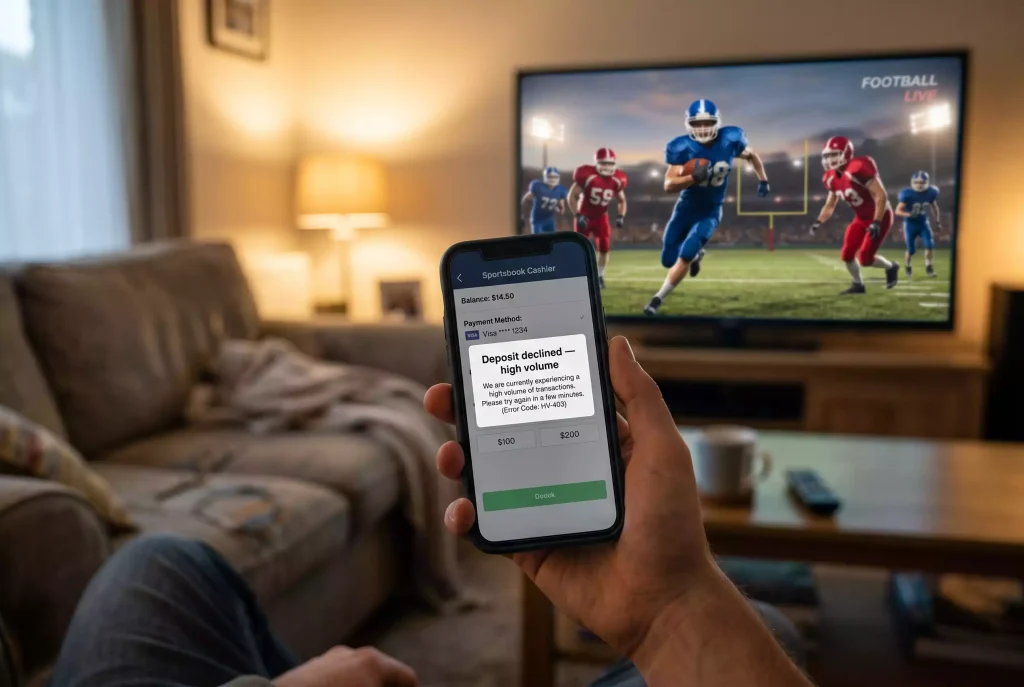
The Sunday the sportsbooks turned into airports
The 2025 Super Bowl generated around $1.39 billion in legal sports-betting handle with 68 million Americans participating, and somewhere between early Sunday afternoon and the coin toss, every major sportsbook’s Mastercard deposit infrastructure experienced the digital equivalent of a packed airport terminal. My own testing that weekend showed a specific pattern that I had seen in previous years but never at this scale: deposits that would clear in 90 seconds on a Tuesday took 18 minutes on Super Bowl Sunday; cards that approved without incident on a normal Saturday got flagged at 4pm ET; payouts requested on Sunday night landed on Tuesday morning rather than within the hour.
Event-weekend Mastercard behaviour is not random. It is the predictable result of concentrated deposit volume hitting systems that were sized for average load rather than peak load, fraud engines running hot because the same signals that indicate coordinated fraud also indicate legitimate event-driven betting, and operator compliance teams working through review queues that grew 15× or 20× over a normal weekend. This piece walks through the deposit volume spike at Super Bowl specifically, why declines surge on event days, what happens to payout timing in the aftermath, how operator capacity planning works behind the scenes, and how a bettor can prep their card to avoid the worst of the friction.
The deposit volume spike
The scale of a Super Bowl deposit surge is hard to internalise without sitting on the operator side of it. A typical tier-one US sportsbook processes tens of thousands of card deposits on an average Sunday. On Super Bowl Sunday that same operator processes hundreds of thousands to millions. The peak load is concentrated in a narrow window — the two hours before kick-off and the first quarter.
The AGA’s pre-game forecast of $1.39 billion in legal bets was built on observed handle growth across prior seasons and on operator capacity expansion. When the actual Sunday numbers came in at or above the forecast, the bottleneck shifted from consumer demand to operator throughput. Cashiers that normally handle 500 concurrent authorisations can handle more on peak days through scaling, but not limitlessly, and the queuing effect starts to become visible to bettors within a few minutes of kick-off.
The 2024 Super Bowl LVIII saw 26 percent of the US adult population participating in betting in some form, and the share attempting a card deposit in the final hours before kick-off was high. The authorisation load on Mastercard specifically is substantial; a large share of those deposits ride on debit Mastercards or credit Mastercards, and the combined traffic to issuers during kick-off windows has measurable effects on issuer-side response times.
The spike is not uniform across operators. Operators that have invested more in infrastructure (the tier-one names) degrade more gracefully than smaller operators. A mid-tier operator on Super Bowl Sunday can experience cashier timeouts that do not happen at larger sites, not because the mid-tier operator is failing but because their infrastructure is sized differently for normal load.
Why declines surge on event days
Declines during event weekends outpace the increase in deposit volume — the decline rate goes up, not just the decline count. The reason is fraud engine behaviour.
Mastercard’s Decision Intelligence layer and the issuer-side fraud engines both weight velocity heavily. On a normal Saturday, a cardholder making three deposits at a sportsbook in an afternoon is scored as unusual and triggers a review. On Super Bowl Sunday, the same cardholder making six or eight deposits is doing something millions of others are doing at the same moment — but the fraud engine scoring that transaction does not know the broader context, it knows only that this card is showing 8x its normal weekly velocity.
The result is that the iGaming decline rate, normally running 30 to 40 percent against 5 to 10 percent for standard e-commerce, spikes further on event days. Clean cards on established accounts still clear; cards with thinner histories or newer verifications see a disproportionate share of declines. The worst-affected are first-time deposits on Super Bowl Sunday itself — a combination of a new-card fraud check plus event-weekend velocity spike produces a high reject rate.
Cross-border transactions are disproportionately affected. A bettor whose regular Mastercard is not available and who tries an alternative card or an offshore operator on event day triggers both event-weekend scoring and cross-border scoring, with the combined score pushing the transaction into certain decline.
The issuer-side response varies. Some issuers scale their fraud review staffing for event weekends and clear flagged transactions faster; others apply the normal review flow and see queues extend from minutes to hours. From the cardholder perspective this is invisible — a decline is a decline — but the delay before a flagged transaction can be retried varies meaningfully by issuer.
Payout lag on Monday
Winning bettors on Super Bowl Sunday face a predictable payout delay on Monday morning. The operator’s fraud and AML review queues have absorbed twenty or thirty times the normal load over the weekend, and even with maximum staffing the queue takes time to process.
For Mastercard Send-enabled payouts on established accounts, the delay is modest — payouts that normally land in 2 minutes might take 30 to 90 minutes on Monday morning. The rail itself is instant; the operator’s release step is what introduces the delay.
For payouts that hit any review flag, the delay is substantial. A $5,000 payout requested Sunday night at a tier-one operator can take 24 to 48 hours to release through a Monday-morning reviewer processing the weekend’s queue. The bettor sees a “pending” status that does not resolve as quickly as it would on a Tuesday.
First-time payouts fare worst. An account that placed its first Super Bowl bets and is now requesting its first payout hits both a new-account review flag and the Monday queue, and can see 2 to 5 business days from request to funds landed. This is where bettor frustration peaks on event weekends — the payout process is visible, the operator’s communication is typically thin, and the timing is noticeably slower than the marketing suggested.
The issuer-side component also slows on Monday. A push-to-card OCT that fires from the operator lands on the issuer instantly under normal conditions; on the Monday after a major event, some issuers queue the posting and release it in batches, adding hours. Most established issuers handle the load fine; smaller issuers occasionally show noticeable delays.
Operator capacity planning
Operators plan for event-weekend load months in advance. The infrastructure work happens in three dimensions: cashier throughput, fraud engine capacity, and customer service staffing.
Cashier throughput is scaled through cloud infrastructure elasticity, and major operators test their peak-load behaviour with synthetic load tests before each NFL season. The test target is typically 5× to 10× peak observed load, which gives headroom for a Super Bowl or championship-game surge. Operators who do the work well see their cashier stay functional through peaks; operators who do not see visible timeouts and errors.
Fraud engine capacity is scaled similarly, but the trade-off is different. A fraud engine that can process high volume but misses signals is not helpful; one that catches signals but queues legitimate transactions is also not helpful. Operators tune the engine for event weekends specifically — accepting a slightly higher false-positive rate in exchange for faster processing — but the tuning is a trade-off with no perfect answer.
Customer service staffing is scaled through third-party support providers and internal shift-rotation planning. A tier-one operator’s support team might be 2× its normal size from Saturday night through Tuesday morning of Super Bowl week. Even with that scaling, wait times on support chat and phone can extend to hours during the peak.
The 84 percent mobile share of US sports betting in 2025 means that most of the surge is mobile-app traffic, and operators have invested particularly in their mobile cashier capacity. Web-based cashiers historically saw more problems during peaks; mobile apps are generally better provisioned. The practical advice for bettors is to use the mobile app during peak windows if both options are available.
How to prepare your card
A few specific actions taken in the week before a major event reduce the likelihood of a declined deposit or a delayed payout.
Verify your account fully before the event if it is not already verified. A partial-verification account can clear small deposits during normal weeks and fail on large event-weekend deposits because the scaled-up fraud engine applies tighter rules. Complete KYC, add a primary card, confirm the address, and update any outdated documents a week or more in advance.
Test the cashier with a small deposit on a normal day the week before. A $20 deposit on a Tuesday confirms the card works at that operator, the issuer approves the MCC, and the deposit credits the account. Doing this a week ahead gives time to resolve any problems before the event weekend — contacting the issuer, trying a different card, moving to an alternative rail if needed.
Consider depositing your event-weekend bankroll before the surge. Depositing Saturday morning rather than Sunday afternoon avoids the peak window entirely. The funds sit in the account, and placing bets during the surge is a much smaller transaction than trying to deposit during it.
Add a note to your card’s account with the issuer about expected high-volume spending. This is not a guarantee against decline, but it reduces the fraud engine’s sensitivity to the unusual velocity. For cards that have had prior declines on gambling transactions, the note can make a meaningful difference.
Use the mobile app rather than web cashier if both are available. Mobile traffic is better provisioned on every major operator. A closer look at how Mastercard specifically behaves in mobile app contexts — including Apple Pay and Google Pay tokenised deposits, which often approve more consistently during peaks — sits in this piece on Mastercard in mobile sportsbook apps and tokenised deposits.
The wider context is set out in our Mastercard betting breakdown.
Peak weekends also stretch payout timing.
