
State Self-Exclusion Registers and Mastercard: NY, NJ, PA Compared
 Available in US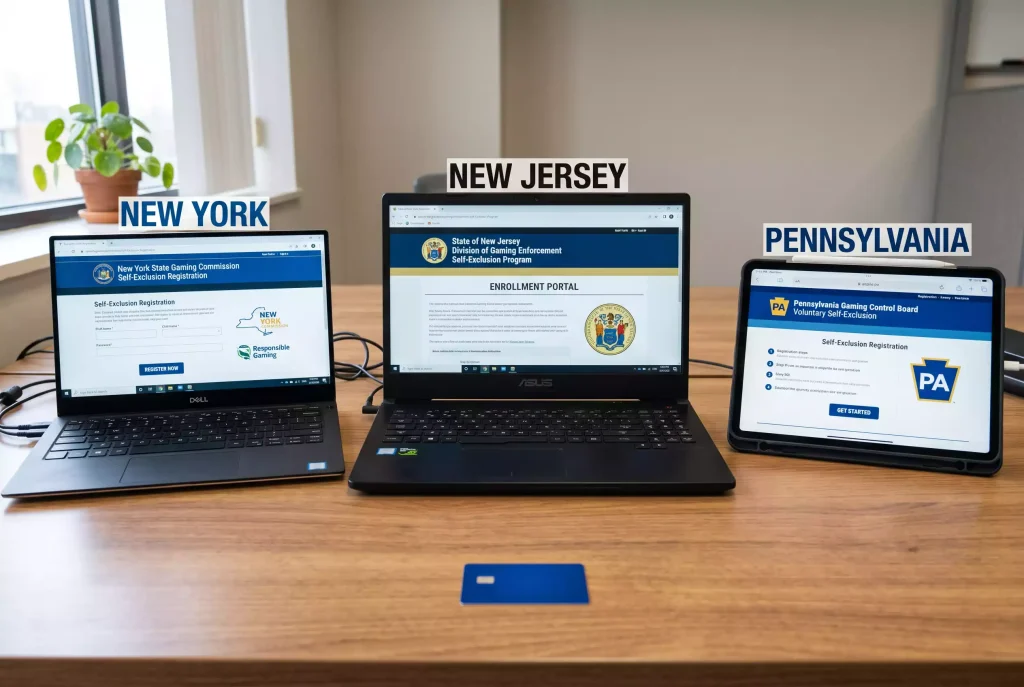
The 50-state patchwork nobody warns you about
When US sports betting scaled after the 2018 PASPA decision, most bettors assumed that self-exclusion, like the sportsbooks themselves, would work on a state-by-state basis. They were right about the structure and wrong about what it meant in practice. A bettor on the New York self-exclusion register who drives across the river to New Jersey can, under current rules, open a licensed sportsbook account in NJ and bet — the NY registration does not travel. The broader framing from AGA leadership is that legalised sports betting is not a societal ill or a threat to the fabric of America, and is instead a success story in how regulation, innovation, and responsibility can come together — a framing that sits comfortably with the balance between the industry’s growth and the protective infrastructure around it. But the protective infrastructure is more fragmented than it needs to be.
The combined commercial gaming sector delivered $78.72 billion in GGR in 2025, and the self-exclusion systems designed to protect the population at the other end of that spending are not yet federal or interstate. This piece walks through how state registers differ in scope and reach, New York’s specifics, New Jersey’s specifics, Pennsylvania’s specifics, and how the actual card-level blocking mechanism compares across the three leading regulated markets.
How state registers differ
Each regulated US state that has legalised sports betting has its own self-exclusion framework, administered by the state’s gaming commission or a designated authority. The specifics — duration options, enrolment process, reversibility, scope — vary enough that a bettor assuming uniformity will be misled.
The duration options are the first variable. Some states offer one year, five years, and lifetime. Others add a six-month minimum or a two-year tier. The choice has the same meaning everywhere — a commitment to exclude for the specified period — but the availability of specific durations varies by jurisdiction.
The enrolment process is the second variable. Some states allow online enrolment through a web portal. Others require an in-person visit to a licensed casino or regulatory office. A few have hybrid approaches with online initiation and in-person finalisation. The friction of enrolment affects how accessible the tool is, and the variance across states is wider than most bettors expect.
The reversibility rules are the third. Most states treat the registration as irrevocable within its chosen period — a one-year registration cannot be cancelled after three months. A handful offer an explicit review process, particularly for lifetime registrations. The design philosophy is consistent (self-exclusion holds through the period of regret) but the specific rules differ.
The scope of coverage is the fourth. State registers typically cover licensed operators within the state only. A New Jersey registration covers NJ-licensed operators but not NY-licensed operators. A Pennsylvania registration does not automatically cover NJ. The geographic fragmentation is the biggest practical gap in the US framework compared with the UK’s GamStop (which covers all UKGC licensees nationally) or Australia’s BetStop (which covers all federally-licensed wagering operators).
New York specifics
New York’s self-exclusion framework is administered through the New York State Gaming Commission and covers licensed mobile sports betting operators alongside casino gambling. The registration is available online through the commission’s portal and can be completed without an in-person visit for online-only products.
Duration options run from one year to lifetime. The one-year option is the entry-level commitment; the five-year option is mid-range; the lifetime option is exactly what it sounds like and cannot be reversed. New registrations take effect within a few business days of enrolment and are queryable by every licensed NY operator during account creation and — in most implementations — at deposit attempts.
The blocking mechanism at NY operators is identity-based, like most self-exclusion frameworks. The register does not interact with Mastercard or any card network directly. A registered bettor presenting any payment instrument at an NY-licensed operator is refused at the identity-verification step, before the payment is attempted. The card itself is neither flagged nor listed.
What NY does not cover is anything outside its regulatory perimeter. A NY resident on the state register who attempts to deposit at a NJ-licensed operator while physically in NJ is not blocked by the NY register. The operator may run its own internal check if it shares exclusion data with NY, but there is no statutory requirement to do so. Offshore and out-of-state licensed operators sit similarly outside the NY register’s reach.
New Jersey specifics
New Jersey’s self-exclusion framework is one of the most mature in the US. The NJ Division of Gaming Enforcement runs the state’s self-exclusion list, which covers both casino and sports betting operators licensed in the state. The list has been in operation for over two decades in various forms and predates the post-2018 expansion of sports betting.
Duration options are one year, five years, and lifetime. The selection is made at enrolment and cannot be changed mid-period. Enrolment can be completed in person at various DGE offices, at licensed casinos, or through verified remote channels for online operators.
NJ’s enforcement is notably strong because the state has a long history with the framework. Operators face penalties for accepting a registered bettor, and the enforcement actions are periodically reported. The cultural expectation that the register will be actively checked is higher than in newer markets, and the operator compliance teams are more experienced.
NJ’s card-level implementation is also identity-based, with the register query firing at the KYC step. What makes NJ’s approach somewhat distinctive is the intersection with the state’s age-verification infrastructure — the DGE maintains identity databases that connect to multiple gambling controls, and the self-exclusion check sits alongside age verification in a common compliance chain. For a registered bettor this means the block is reliable; for the operator it means the compliance investment serves multiple purposes.
The NJ framework does not reach across state lines. A NJ registered bettor attempting to deposit at a NY-licensed operator is not automatically blocked by NJ’s register — the NY operator is not querying the NJ list. This is one of the reasons advocates have called for interstate register sharing, though the legal and data-protection framework to enable it is still evolving.
Pennsylvania specifics
Pennsylvania’s approach is administered by the Pennsylvania Gaming Control Board and covers licensed casino and sports betting operators in the state. The register is available online through the PGCB portal and includes options for one-year, five-year, and lifetime exclusion.
PA has historically taken a more restrictive stance on specific gambling products than some peer states. PA has imposed restrictions on credit-card use for certain gambling products, a partial restriction that interacts with the self-exclusion register at the operator compliance level. A registered bettor attempting to deposit with a credit card faces a layered rejection — the identity check from the register fires first, and the credit-card restriction would fire independently at operators that apply it.
The duration options mirror NJ’s, and the enrolment process is accessible online. PA’s framework is newer than NJ’s but more mature than some peer markets that legalised sports betting more recently.
PA’s card-level approach is identity-based, and the register query runs at the operator’s KYC step. The operator’s internal systems may also apply product-level restrictions — credit-card blocks, deposit-size caps, velocity limits — that stack on top of the register check. A registered bettor is blocked by the identity query; a non-registered bettor using a credit card may still face operator-level restrictions depending on the specific product and operator.
Like NJ and NY, PA’s register does not cover out-of-state operators. The federation of state frameworks remains the dominant US model, and while some industry voices have argued for interstate sharing or a federal-level framework, the current architecture does not support it.
Card-blocking reach: what the state registers actually do to your Mastercard
None of the state self-exclusion registers block Mastercards directly. All of them block the identity of the registrant at the operator level, which in effect prevents the Mastercard attached to that identity from being used at licensed operators within the state’s jurisdiction. The mechanism is identity, the effect is card-usage-within-state.
This has implications for what the card looks like at merchants generally. A Mastercard belonging to a bettor on the NY self-exclusion register continues to work for every other purpose — retail, dining, travel, online shopping. Only the attempt to use it at a NY-licensed gambling operator is blocked. The card is not listed at the network, not flagged at the issuer, and not restricted at any merchant that is not running an NY-operator-level compliance check.
The gap is interstate use. A registered NY bettor using the same Mastercard at a NJ-licensed sportsbook is not blocked by the NY register, and the NJ operator will typically accept the deposit unless the bettor is also registered in NJ. Bettors with out-of-state gambling intentions can and sometimes do exploit this gap. For a bettor whose goal is genuine self-exclusion, the practical recommendation is often to register in every state where they might plausibly bet — or, better, to combine the state register with a bank-side gambling block on the Mastercard that fires on the MCC regardless of which state the operator is in.
The combination approach is the most robust. A self-exclusion register catches the operator-level check; a Mastercard gambling block catches the MCC regardless of operator jurisdiction; the two together cover the gap each leaves individually. A detailed map of where US operators accept Mastercard deposits and how the state-by-state picture plays out at the cashier sits in this analysis of Mastercard sports betting state by state across the US.
The wider context is set out in our Mastercard betting breakdown.
The UK equivalent is GamStop.
